Public Record
Since 2021 the courts have repeatedly protected our membership against those who control AFRINIC. Every step is here, dated, with the original documents.
We have been a member of AFRINIC, the regional internet registry for Africa, since 2013. When AFRINIC’s management moved to terminate our membership in 2021, the Supreme Court of Mauritius restrained AFRINIC. When AFRINIC was left without a board able to act, the Court placed it in receivership on our application, to secure elections under its constitution. Throughout, we have defended the rule of law, democratic governance of a members’ institution and the constitutional separation of powers. Anyone can check each step against the original documents.
Member rights
1 November 2026 · Company statement
AFRINIC’s Receiver wants us removed from the register the Court ordered us onto.
Our statement of 1 November 2026 answers the communiqué of 31 October: every eligible Resource Member belongs in the register, nothing done outside the Court should defeat its directions, and the proposed constitution would weaken member control. We oppose the application in SC/COM/MOT/000757/2025 to validate the September 2025 board appointments; as at 1 November 2026, the confirmation it seeks has not been granted.
Lu Heng’s Note 72
The Bill of Rights of Uniqueness Coordination
Which rights keep networks running, records accurate, and exit real?
Timeline
What those running AFRINIC did, what the courts decided and how we responded, newest first. Each entry links to its source.
Filled in blue: court decisions and official records in our favour.
- Company statement
We take the Receiver’s conduct to the Court that appointed him
Because the Receiver is trying to prevent the lawful execution of a judgment, our communiqué sets out four steps. We will bring his conduct before the Bankruptcy Division of the Supreme Court, which appointed him, and seek contempt sanctions, directions, costs and his removal; file a formal complaint with the Director of Insolvency; notify the Registrar of Companies not to entertain his request to remove us, since the entry rests on the Court’s orders and rule; and respectfully ask the Prime Minister for an investigation, within the Companies Act, into AFRINIC’s membership: why, on our information, more than 2,000 resource members have been left off its register, why a new constitution is being drafted to remove them for good, and who authorised the appointment of directors whose election is still before the Court. We have confidence in the independence of the judiciary and the institutions of Mauritius.
Read our communiquéLu Heng’s Note 63
On When the Bookkeeper Auditions for Olympus
What happens when a bookkeeper begins to believe the ledger is a throne?
- Company statement
We put the Receiver on notice: the Court’s orders are changed only in court
Our communiqué answers the Receiver’s point by point. The Order of 4 April 2025 directed that we be added to AFRINIC’s register of members as a Member under section 91 of the Companies Act 2001, and AFRINIC was a party to those proceedings. In a written undertaking to the Court dated 10 June 2025 and signed by the Receiver, AFRINIC undertook to rectify its records within 15 days of any order, and the Court recorded it in the Order of 11 June 2025. The 15 days passed without rectification, so we executed the judgment by praecipe of 2 October 2026. A party who objects to an order of the Supreme Court must apply to the Court, seek a stay or appeal, and the Receiver, an officer of the Court, is no exception; we are confident that the authorities will decline to be drawn into a matter the Supreme Court has already decided. We reserve all our rights, including as regards contempt of court, and will bring the Receiver’s conduct before the Court that appointed him.
Read our communiquéLu Heng’s Note 2
The Internet’s Address Book — and Why “Digital Sovereignty” Is a Dangerous Fantasy
If a registry is only an address book, what does “digital sovereignty” actually control?
- Company statement
We answer the Receiver’s demand to strike us from the register
Our statement rejects the demand, made in AFRINIC’s name by its Receiver, to remove us from its register of members, calls for every eligible Resource Member to be recognised and says nothing done outside the Court should defeat its directions.
Read our statementLu Heng’s Note 54
On Who Gets to Speak for a Continent, a Community, or “The End User”
Who has a mandate to speak for a continent, a community, or “the end user”?
- AFRINIC statement
AFRINIC’s Receiver demands our removal from the register the Court ordered us onto
AFRINIC’s Receiver objects to our entry in its register of members, made on 9 October 2026, and says his legal notice of 29 October demanded that the Registrar of Companies remove us at once, with copies to the Prime Minister, the ICT Minister, the Attorney General and the State Law Office. Yet his own communiqué says a Supreme Court rule of 9 October 2026 certifies the outcome of the orders of 4 April and 11 June 2025, the second made on AFRINIC’s own application, and it cites no court order for the removal he demands. In asking officials to undo a court order, we say, the Receiver breaches the constitutional separation of powers.
Read AFRINIC’s communiquéLu Heng’s Note 63
On When the Bookkeeper Auditions for Olympus
What happens when a bookkeeper begins to believe the ledger is a throne?
- Official record
The Registrar of Companies’ record of AFRINIC lists us as a member from 9 October 2026
The Registrar of Companies’ record of African Network Information Centre (AfriNIC) Ltd, file C49338, issued on 28 October 2026, lists Cloud Innovation Ltd among AFRINIC’s members with a start date of 9 October 2026, the date of the Court’s rule. The only other members on the record are the eight directors, each registered on 12 September 2025; the record also names the Receiver the Court appointed on 12 February 2025. The next day, the Receiver’s Legal Notice of 29 October 2026 asked the Registrar to remove our entry; our communiqué of 2 November 2026 answers it.
Read the record, page 2 (PDF)Lu Heng’s Note 72
The Bill of Rights of Uniqueness Coordination
Which rights keep networks running, records accurate, and exit real?
- Court decision
The Court’s rule of 9 October 2026 restates it: Cloud Innovation is a Member, and the Registrar must enter it
After we executed the judgment by praecipe of 2 October 2026, the Supreme Court draws up the order of 4 April 2025 in SC/COM/PET/000275/2021 as varied in SC/COM/MOT/000399/2025, witnessed by the Chief Justice: AFRINIC’s register of members is to be rectified to add us as its member under section 91 of the Companies Act, in the category of Member; the Registrar of Companies is to make the proper entries in AFRINIC’s company records, including its register of members, within 14 days; and the entries made under the order as first granted are to be removed and replaced. AFRINIC’s written undertaking of 10 June 2025 to rectify its records within 15 days is recorded again. The Registry certified the copy the same day.
Read the rule, page 2 (PDF)Lu Heng’s Note 1
On AFRINIC, RIR Governance, and the Myth of “Community Ownership”
What does “community ownership” mean when a few insiders control the rules?
- Court decision
AFRINIC’s Receiver obtains an order against a claim no one made
Without notice to us, AFRINIC’s Receiver obtained an interim order in SC/COM/WRT/000338/2026 against Cloud Innovation over a press release published by LARUS, a separate company. The order restrains statements that falsely attribute to the Supreme Court any approval of the leasing or commercialisation of AFRINIC-allocated IP resources, and requires the removal of any statement suggesting such approval. No one made that claim: a lawful business needs no court approval, and no one ever said it did. We learned of the order from AFRINIC’s communiqué, not from formal service. It is an interim order, not a final judgment: it does not decide whether IPv4 leasing is lawful, who owns IP addresses, our place in AFRINIC’s register of members or any LARUS business model.
Read the order (PDF)Lu Heng’s Note 60
On How Thick Governance Destroyed the Obscurity It Needed to Survive
Why is public attention dangerous to a system that survived in the dark?
- Court decision
On our application, the court halts the inspection under the Proclamation
On our urgent application, heard without notice, the Judge in Chambers issues an interim injunction restraining the inspector appointed by the Registrar of Companies under the Government’s Proclamation from carrying out any inspection under that mandate, restraining the Registrar from mandating any inspection that exceeds or breaches Part XV of the Companies Act, and restraining both from giving effect to the mandate as the Proclamation frames it. We defend the constitutional separation of powers: in our constitutional complaint we say the measures would call into question judgments the courts had already delivered and set up a parallel system of justice. The inspector withdrew from the role by a letter of 18 August 2025 (Le Défi, 20 August 2025).
Read the order (PDF)Lu Heng’s Note 2
The Internet’s Address Book — and Why “Digital Sovereignty” Is a Dangerous Fantasy
If a registry is only an address book, what does “digital sovereignty” actually control?
- Company statement
We warn that the Receiver’s new election rules break AFRINIC’s constitution
Writing again to NRO and ICANN leadership, we object that the Receiver obtained an extension of his mandate to 30 September 2025 without our knowledge or consent, though the receivership began on our application. We also object that his new election rules, which ban proxies and powers of attorney and allow online voting only, depart from AFRINIC’s bylaws and from the Court’s order to hold the election under AFRINIC’s constitution.
Read the follow-up letterLu Heng’s Note 41
On Power, Legitimacy, and the AFRINIC Lock-In — When Control Targets Your Assets
Where does power actually come from, if not from the vote?
- Company statement
We propose a successor registry for Africa’s number resources
With ICANN itself warning that AFRINIC’s ability to function as a regional internet registry was in jeopardy, we ask NRO and ICANN leadership to designate a successor registry under ICP-2, so that African networks keep their registry services without interruption. We report that we have petitioned the Supreme Court to wind AFRINIC up under its supervision.
Read the proposalLu Heng’s Note 70
The Registry Continuity Fallacy — Protect the Ledger, Not the Gatekeeper
What must survive an institution’s failure: the ledger, or the gatekeeper?
- Company statement
We call for an orderly wind-up after one vote voids an election
We say the Receiver’s annulment of the entire June election over “one disputed proxy” vote, “silencing hundreds of valid votes”, has left AFRINIC unable to hold a valid election, while ICANN warns that it could withdraw recognition. Rather than wait for a disorderly collapse, we are prepared to apply for AFRINIC’s liquidation under court oversight, with its registry services carried on without interruption.
Read the statementLu Heng’s Note 52
What breaks when registry power grows but its liability stays at one hundred dollars?
- Company statement
We object to the annulment of AFRINIC’s election
We object to the suspension of the Board election and to its annulment by the Receiver: neither step appears supported by the Court’s mandate, AFRINIC’s bylaws or the election guidelines, and many members were left unable to exercise their voting rights. Every decision, we say, must follow the established legal framework.
Read the statementLu Heng’s Note 73
The Multi-Stakeholder Mirage – How the Multi-Stakeholder Model Turned Attendance Into Mandate
When did attendance start to count as a mandate?
- Court decision
ICANN’s case corrects a category and leaves our membership order in place
In SC/COM/MOT/000442/2025, an application against AFRINIC’s Receiver brought by ICANN, which the court finds has no standing, and to which we were not a party, the Supreme Court orders AFRINIC and its Receiver to inform all resource members, by 20 June 2025, of our erroneous registration as a “registered member” and that the Receiver has removed that entry at the Registrar of Companies. The ruling calls the entry a “wrong classification” and calls us “simply a resource member”. It refuses ICANN’s demand to dismantle the nominations committee on that premise, calling the insistence “inappropriate”. It does not vary or cancel the order of 11 June 2025, which directs that we be entered in AFRINIC’s register as a member under section 91 of the Companies Act; the two decisions stand together.
Read the ruling, pages 2–4 (PDF)Lu Heng’s Note 44
On the “Capture” Paradox — and the Verified Challenger They Manufactured
If governance is truly bottom-up, why is a challenger from inside called “capture”?
- Court decision
Court orders AFRINIC to enter us in its register of members
On AFRINIC’s own application in SC/COM/MOT/000399/2025, the Supreme Court varies its order of 4 April 2025 in SC/COM/PET/000275/2021: AFRINIC’s register of members is to be rectified to add us as its member under section 91 of the Companies Act, in the category of Member, and the Registrar of Companies is to make the proper entries, replacing those made under the order as first granted. AFRINIC’s Receiver signed AFRINIC’s written undertaking to rectify its records within 15 days, and the court records it.
Read the order, page 2 (PDF)Lu Heng’s Note 1
On AFRINIC, RIR Governance, and the Myth of “Community Ownership”
What does “community ownership” mean when a few insiders control the rules?
- Court decision
On our 2021 petition, the court orders us entered in AFRINIC’s register
Nearly four years after our petition of 24 May 2021 in SC/COM/PET/000275/2021 to have AFRINIC’s register of members rectified to include us (2022 SCJ 253, page 9), the Supreme Court grants an order on it, and the Registrar of Companies makes entries in AFRINIC’s register under that order. On AFRINIC’s own application, the court varies it on 11 June 2025 to direct our entry as a member under section 91 of the Companies Act.
Read the order of 11 June 2025 that varies it, page 2 (PDF)Lu Heng’s Note 19
Why RIRs Do Not Have Authority — and Why “Community Sovereignty” Breaks the System
What is the difference between authority and cooperation, and which one do registries have?
- Company statement
We call for a fair election and an end to unauthorised allocations
Publishing the transcript of 25 November 2024, we call for a free and fair election under judicial supervision. Members admitted without the Official Receiver’s consent since September 2023 have no vote, and addresses issued without his permission are, we say, highly concerning: no allocation should be made without his approval.
Read the statement and documentsLu Heng’s Note 38
On Stewardship, Scarcity, and the Hypocrisy of “Community Control”
What does “community control” become once the resource is scarce?
- Court decision
On our motion, the court sets a June 2025 deadline for AFRINIC’s elections
On our motion in SC/COM/MOT/000859/2024, the Supreme Court orders AFRINIC, at the Receiver’s request, to conduct the election process by the end of June 2025, as the two months set on appeal could not be met. The court records the Receiver’s undertakings, including no voting rights for members admitted without the Receiver’s consent since 19 September 2023, and otherwise sets the motion aside.
Read the order, page 2 (PDF)Lu Heng’s Note 17
On the ICP-2 Revision, RIR Failure Standards, and Why Power Must Remain Bottom-Up
Who should decide when a registry has failed: its members, or the institutions above it?
- Court document
At the hearing, the Receiver reveals addresses issued without his permission
At the hearing on our motion in SC/COM/MOT/000859/2024, the Official Receiver tells the court that, despite his instruction to AFRINIC’s staff, “seven IP addresses have been issued without my permission” between 15 and 31 October 2024, and that he himself has approved none. He undertakes that no new IP resources will be allocated, and the court records his undertakings. The court rules that those admitted as members without his consent since 19 September 2023 are not to be considered members with voting rights.
Open the transcript (PDF)Lu Heng’s Note 42
How a Neutral Bookkeeper Became a Fragile Power
How did a bookkeeper become a fragile power once the ledger turned into capital?
- Court decision
Appeal brought in AFRINIC’s name without authority fails
In 2024 SCJ 473, the Court of Civil Appeal upholds our objections that the appeal against the receivership, brought in AFRINIC’s name by a former director and by lawyers with no mandate, was brought without authority, and sets it aside. It restores the receivership order of 12 September 2023 and gives the Official Receiver two months to complete the election process.
Read 2024 SCJ 473, pages 18–19 (PDF)Lu Heng’s Note 32
On The Agency Problem at the Core of Internet Governance
What happens when those who govern a system neither own it nor bear its risks?
- Company statement
We welcome the receivership and the elections it orders
We welcome the judgment of 12 September 2023, which found the orders we sought “fully justified, reasonable, and fair”, placed AFRINIC under the Official Receiver to protect its assets and ordered elections under its constitution within six months. We call on the internet community to support the Receiver in delivering them.
Read the statementLu Heng’s Note 21
Why I Act to Protect the Number Registry System — and Why This Is About Stability
Why would the largest beneficiary of a stable registry system fight it?
- Court decision
On our application, the court places AFRINIC in receivership
On our application, the Supreme Court finds AFRINIC’s preliminary objections unsubstantiated and, with our affidavit unrebutted, the orders we sought “fully justified, reasonable, and fair”. It appoints the Official Receiver to preserve AFRINIC’s assets and the value of its business and to see that elections are held under its constitution within six months, subject to any extension the court grants. It restrains AFRINIC from relocating, merging, restructuring or submitting to a takeover.
Read the judgment, PDF pages 8–10Lu Heng’s Note 17
On the ICP-2 Revision, RIR Failure Standards, and Why Power Must Remain Bottom-Up
Who should decide when a registry has failed: its members, or the institutions above it?
- Court decision
AFRINIC’s lawyers cannot rely on a 2021 board resolution
In SC/COM/MOT/000156/2023, the Supreme Court holds that AFRINIC’s counsel and attorney cannot rely on a 2021 board resolution to appear for it: AFRINIC has four directors, too few for a board quorum, and no chief executive. The next day the court places AFRINIC in receivership.
Read the ruling, PDF pages 3–7 - Company statement
We win against the bid to deny us access to justice
We publish 2022 SCJ 253 with our statement. The court has thrown out the objection, raised in AFRINIC’s name by its management, that we were abusing its process, and found that we are not a vexatious litigant, but had no choice but to protect our rights before an independent court. We look forward to a hearing on the merits.
Read the statement and judgmentLu Heng’s Note 61
Running-Code Betrayal: How the RIR System Turned Consensus Against the Technical Community
Does “community consensus” give a room the right to rule over networks that are already running?
- Court decision
Court rejects AFRINIC’s claim that we abused the process
In 2022 SCJ 253, the Judge in Chambers rejects AFRINIC’s objection that our application of 3 December 2021 is an abuse of process, finding that a new circumstance prompted each of our applications. The court holds that Cloud Innovation “cannot be taxed for resorting to an independent court to safeguard its rights”, declines to treat us as a vexatious litigant and warns that upholding the objection “would imperil the future administration of justice”. Both parties accept that the dispute is a serious matter to be tried.
Read 2022 SCJ 253, pages 10 and 15–17 (PDF)Lu Heng’s Note 69
The Stability Fallacy in the RIR Argument
Whose stability is at stake: the institution’s, or the networks people actually use?
- Company statement
AFRINIC’s management ignores our offer of mediation without conditions
We offer to resolve the dispute through confidential mediation, without conditions, and AFRINIC’s management does not even acknowledge the offer. We say this reflects a failure of leadership and good governance at AFRINIC, which needs new leadership.
Read the statementLu Heng’s Note 43
What changed between believing in reform from within and expecting a structural migration by 2033?
- Court decision
Our earlier appeal closes: the December injunction already protects us
The Court of Civil Appeal sets aside our appeal against the judgment of 7 July 2021 without ruling on the merits, because we had since obtained the interim order of 3 December 2021 protecting our membership.
Read 2022 SCJ 253, pages 8 and 10 (PDF) - Company statement
We warn clients that AFRINIC’s management has repeatedly breached court orders
Updating our clients at the end of the year, we say AFRINIC’s management has tried to discredit us while repeatedly breaching the Judge’s orders, that we have brought proceedings over those acts and for contempt of court, and that injunctions, including the order of 3 December 2021, protect our rights while the courts decide.
Read the statementLu Heng’s Note 65
Running-Code Primacy: The Patch Needed to Preserve the Internet’s Original Design
What single patch would restore the Internet’s original design at the registry layer?
- Court decision
Court restrains AFRINIC until our case is decided
After AFRINIC’s management wrote on 1 December 2021 that our services “may come to an end at any time”, the Judge in Chambers, on our application, restrains AFRINIC, pending the final determination of the dispute, from acting on its Board resolution of 8 July 2021 or its letter of 1 December 2021 to terminate our resource membership, and from giving effect to its decision in breach of its undertaking of 15 July 2021.
Read 2022 SCJ 253, pages 1 and 10 (PDF)Lu Heng’s Note 55
On Why I Am Certainly Not the First Victim, and Likely the First Survivor
Why does a system that produces many victims keep them from seeing one another?
- AFRINIC decision
AFRINIC’s management goes back on its word to the Judge
At a sitting before the Acting Deputy Master and Registrar, not before the Judge who recorded it, AFRINIC’s counsel announces that AFRINIC is withdrawing its undertaking of 15 July 2021, which was given without condition and with nothing asked of us in return. In 2022 SCJ 253 the court declines to comment on “the propriety of the procedure adopted to withdraw an undertaking given before a Judge”, though it “cannot turn a blind eye in the interests of fairness and justice”.
Read 2022 SCJ 253, pages 13–16 (PDF)Lu Heng’s Note 47
What does a greengrocer’s slogan teach about institutions that keep performing belief?
- Court decision
Our application for a conservatory seizure is set aside
Our application of 3 September 2021 to the Commercial Division, for an order authorising a conservatory seizure of the 6.9 million unused IPv4 addresses held by AFRINIC, is set aside. Our membership remains protected by AFRINIC’s undertaking to the Judge of 15 July 2021.
Read 2022 SCJ 253, page 13 (PDF) - AFRINIC decision
AFRINIC’s management cites child abuse images, then refuses to say where they are
Citing an affidavit it had filed in court, AFRINIC’s management writes that websites using addresses allocated to us carry illegal content, including some with indecent images of children, and demands to know why we do not monitor them, on pain of suspension or termination. We host no websites: our customers are network operators serving hundreds of millions of end users in 60 countries. We asked them to tell us within four hours which addresses were involved, so the sites could be shut down; they refused. Policing takes the power to watch people, a state’s power that a private company in Mauritius should never hold. The Court later found that, after this letter, we had no alternative but to seek its protection.
Read 2022 SCJ 253, page 15 (PDF)Lu Heng’s Note 28
Why Registries Must Never Become Enforcers
Why is an address book the wrong instrument for punishment?
- Company statement
We report that AFRINIC’s management defied the Court until warned of contempt
Setting out the July orders for our customers, we report that AFRINIC’s management refused to obey the injunction of 13 July 2021 and, even after undertaking to the Judge on 15 July to comply, restored our membership only that night, after being warned of contempt proceedings. We say it acted in bad faith and on frivolous grounds, and that we remain open to any reasonable resolution.
Read the statement and attachmentsLu Heng’s Note 62
Mandate Laundering: From RIR Fantasy to Transition Architecture
When does an institution stop performing authority and start believing it possesses it?
- Court decision
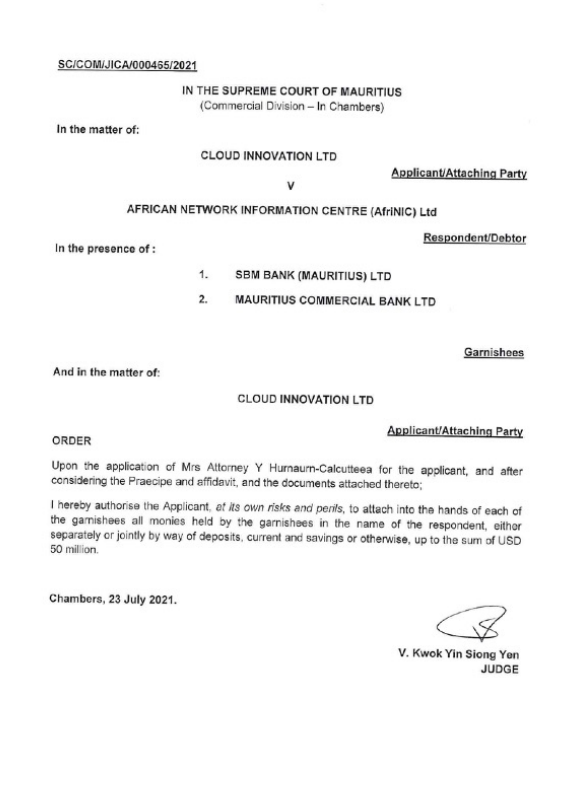
Court authorises us to attach USD 50 million of AFRINIC’s funds
On our application, in support of our claim for damages over the termination, the Judge in Chambers of the Commercial Division authorises us, at our own risk, to attach up to USD 50 million held in AFRINIC’s name at two Mauritian banks. An application entered on 27 July 2021 to validate attachment proceedings is later set aside on a formal ground: our attorney-at-law had not been given power to initiate them (2022 SCJ 253, page 12).
Open the order (image)Lu Heng’s Note 51
On Why the Present Registry Model Becomes Impossible Once IPv4 Becomes a Real Asset
Can a clerical liability shell govern an asset class worth trillions?
- Court decision
Still defying the order, AFRINIC’s management gives the Judge an unconditional undertaking
Our counsel tells the Judge in Chambers that AFRINIC, served with the injunction two days earlier, is still not complying with it (2022 SCJ 253, page 11). AFRINIC’s representative then undertakes to comply with the order once its terms have been explained, and is told the consequences of a breach. On our motion, the judge records the undertaking, with no condition attached, and discharges the interim order on that basis; the application is otherwise set aside.
Open the order, page 2 of 2 (image)Lu Heng’s Note 20
On Reality Layers, Symbolic Power, and Why Clarity Feels So Hostile
Why does clarity feel hostile to those who depend on ambiguity?
- Company statement
We explain why the termination decided by AFRINIC’s management is unjust
We publish our letter with the correspondence. The accusations of policy violations made by AFRINIC’s management, we say, rested on its own misreading of its policies and of BGP routing, as our reply of 13 July 2020 explained. Eight months later, on the first day of Mauritius’s second national lockdown, it gave us a month to supply detailed utilisation data for our address blocks or face termination at its “sole discretion”. We call the termination unnecessary, unreasonable and unjust, and a danger to hundreds of millions of end users.
Read the letter and attachmentsLu Heng’s Note 67
When the Water Company Says Your House Belongs to It
If the water company claimed your house, would you accept it?
- Court decision
Court blocks AFRINIC’s Board resolution against us
On our application, the Judge in Chambers restrains AFRINIC from acting on its Board resolution of 8 July 2021, from freezing or reclaiming the resources allocated to us and from denying us access to the AFRINIC WHOIS database. The order is served on AFRINIC the same day; as 2022 SCJ 253 records, it is “deliberately flouted” by those then running AFRINIC.
Open the order, page 1 of 2 (image)Lu Heng’s Note 50
On When a Registry Can Destroy Without Cost — and Why the System Then Dies With It
What happens when a registry can destroy a network at a cost of one hundred dollars?
- Court decision
Stay refused on a power-of-attorney point
The Judge in Chambers sets aside our application to stay execution of the judgment of 7 July 2021, holding that a stay would restore the interim orders of 29 March 2021 in breach of the Deposit of Powers of Attorney Act. The next day the court restrains AFRINIC’s Board resolution against us.
Read 2022 SCJ 253, page 10 (PDF) - Court decision
Our first application against the Board resolution is set aside
The Judge in Chambers sets aside our urgent application of 10 July 2021 against the Board resolution, holding, among other grounds, that the application asked the judge to sit on appeal from the judgment of 7 July 2021. We apply again, and two days later the court restrains AFRINIC from acting on the resolution.
Read 2022 SCJ 253, page 11 (PDF) - AFRINIC decision
A day later, AFRINIC’s Board resolves to terminate our membership
The day after the first interim orders were set aside on a formal ground, AFRINIC’s Board resolves to terminate our membership with immediate effect, with a 90-day grace period before the number resources are reclaimed. We are told on 9 July 2021, just past midnight.
Read 2022 SCJ 253, page 11 (PDF)Lu Heng’s Note 34
On Why RIR Enforcement Creep Is the Silent Killer of IPv4 Liquidity — and Why It Must Be Stopped
How do auditing and pre-approval turn a market into a ration queue?
- Court decision
First interim orders set aside on a formal ground
On AFRINIC’s preliminary objections, the Judge in Chambers sets aside the application in which the interim orders of 29 March 2021 were granted, because no agent or attorney-at-law had been appointed to represent us and give evidence, as the Deposit of Powers of Attorney Act requires: a power of attorney we could not provide during the national lockdown that began the day AFRINIC’s management wrote to us. We appeal the next day.
Read 2022 SCJ 253, page 10 (PDF) - Court decision
Court halts AFRINIC’s move against our membership
The letter of 10 March 2021 from AFRINIC’s management, sent on the first day of Mauritius’s national lockdown, “when access to justice was very limited” (2022 SCJ 253), gave us 30 days to answer what the court later called “purported breaches” or face termination at its “sole discretion”. On our application, the Judge in Chambers restrains AFRINIC from terminating, suspending or revoking our resource membership pending determination of the application.
Read 2022 SCJ 253, page 9 (PDF)Lu Heng’s Note 53
On Internet Number Resources Are Not Political Property
Why is a service region not a sovereign community?


Court cases
The principal decisions in our proceedings with AFRINIC, including those that protected our membership, and a pending application, oldest first, each with its source, as at 1 November 2026.
Printable fact sheet| Case | Court | Date | Description | Document or source |
|---|---|---|---|---|
| 2022 SCJ 253S.N. 1947/2021 | Supreme Court of MauritiusJudge in Chambers | Interlocutory judgment on Cloud Innovation’s application of 3 December 2021. The court rejected AFRINIC’s abuse-of-process objection: Cloud Innovation could not be faulted for turning to an independent court to safeguard its rights. The interim order of 3 December 2021 barred AFRINIC from terminating Cloud Innovation’s membership pending final determination. | ||
| SC/COM/MOT/000156/2023 | Supreme Court of MauritiusCommercial Division | On Cloud Innovation’s application under section 178 of the Companies Act, the court rejected AFRINIC’s preliminary objections, found the orders sought “fully justified, reasonable, and fair”, placed AFRINIC under the Official Receiver to preserve its assets and see that elections are held under its constitution, and barred any relocation, takeover, merger or restructuring. | ||
| 2024 SCJ 473Record No. 1808 | Supreme Court of MauritiusCourt of Civil Appeal | AFRINIC’s appeal against the ruling of 11 September 2023 and the receivership judgment failed. The Court of Civil Appeal upheld Cloud Innovation’s objections that the appeal had been lodged without authority, set it aside, restored the receivership order of 12 September 2023 and directed the Official Receiver to complete the election process within two months. | ||
| SC/COM/MOT/000859/2024 | Supreme Court of MauritiusCommercial Division | On Cloud Innovation’s motion, the court ordered AFRINIC, at the Official Receiver’s request, to conduct the election process by the end of June 2025, with a report to be filed by mid-December 2024. It recorded the Official Receiver’s undertakings on membership and voting rights; the motion was otherwise set aside. | ||
| SC/COM/MOT/000399/2025 | Supreme Court of Mauritius | On AFRINIC’s own application, the court varied the order of 4 April 2025 in SC/COM/PET/000275/2021: Cloud Innovation to be entered as AFRINIC’s member under section 91 of the Companies Act, in the category of Member, in its register and at the Registrar of Companies. The court recorded AFRINIC’s undertaking to rectify its records within 15 days. | ||
| SC/COM/MOT/000442/2025 | Supreme Court of MauritiusCommercial Division | ICANN’s application against AFRINIC’s Receiver, which the court found ICANN had no standing to bring; Cloud Innovation was not a party. The court ordered a communiqué that the company’s registration as a “registered member” had been an error, since removed, and called it “simply a resource member”. It left in place the order of 11 June 2025 for Cloud Innovation’s entry as a member, and otherwise set the application aside. | ||
| SC/COM/MOT/000757/2025 | Supreme Court of Mauritius | Pending as at | Application by AFRINIC and its Receiver to end the receivership, discharge the Receiver and have the board appointments from the September 2025 election declared valid. Cloud Innovation opposes it, contending that the election’s departures exceeded the Receiver’s mandate and breached the Court’s orders. |
Original documents
Court documents, correspondence and supporting files published with our statements, and court files first published by AFRINIC. Each file opens in its original format.
Search the recordCourt decisions and records
- Registrar of Companies’ record of AFRINIC, listing Cloud Innovation Ltd as a member from 9 October 2026, 28 October 2026Open original: Registrar of Companies’ record of AFRINIC, listing Cloud Innovation Ltd as a member from 9 October 2026, 28 October 2026Company records extract · Registrar of Companies, Mauritius · File No. C49338 · 28 October 2026
- Rule restating the order to enter Cloud Innovation in AFRINIC’s register of members, 9 October 2026Open original: Rule restating the order to enter Cloud Innovation in AFRINIC’s register of members, 9 October 2026Court rule, varying the Order of 4 April 2025 · Supreme Court of Mauritius · SC/COM/PET/000275/2021, as varied in SC/COM/MOT/000399/2025 · 9 October 2026
- Interim injunction, AFRINIC Ltd v Cloud Innovation Ltd, 14 May 2026Open original: Interim injunction, AFRINIC Ltd v Cloud Innovation Ltd, 14 May 2026Court order, issued 15 May 2026 · Supreme Court of Mauritius · SC/COM/WRT/000338/2026 · 14 May 2026
- Interim injunction against the inspection under the Proclamation, 7 August 2025Open original: Interim injunction against the inspection under the Proclamation, 7 August 2025Court order · Supreme Court of Mauritius · JIC/841/25 · 7 August 2025
- Amended minutes and oral ruling, ICANN v the receiver of AFRINIC, 19 June 2025Open original: Amended minutes and oral ruling, ICANN v the receiver of AFRINIC, 19 June 2025Court minutes and oral ruling · Supreme Court of Mauritius · SC/COM/MOT/000442/2025 · 19 June 2025
- Order on AFRINIC’s register of members, with the Receiver’s written undertaking, 11 June 2025Open original: Order on AFRINIC’s register of members, with the Receiver’s written undertaking, 11 June 2025Court order, with written undertaking of 10 June 2025 · Supreme Court of Mauritius; undertaking signed by AFRINIC’s Receiver · SC/COM/MOT/000399/2025 · 11 June 2025
- Court order in SC/COM/MOT/000859/2024, 25 November 2024Open original: Court order in SC/COM/MOT/000859/2024, 25 November 2024Court order · Supreme Court of Mauritius · SC/COM/MOT/000859/2024 · 25 November 2024
- Transcript of the hearing in SC/COM/MOT/000859/2024, 25 November 2024Open original: Transcript of the hearing in SC/COM/MOT/000859/2024, 25 November 2024Transcript · SC/COM/MOT/000859/2024 · 25 November 2024
- Appeal judgment, AFRINIC Ltd v Cloud Innovation Ltd & Anor, 15 October 2024Open original: Appeal judgment, AFRINIC Ltd v Cloud Innovation Ltd & Anor, 15 October 2024Judgment · Supreme Court of Mauritius, Court of Civil Appeal · 2024 SCJ 473 · 15 October 2024
- Oral judgment appointing the Official Receiver for AFRINIC, with Cloud Innovation's press release, 12 September 2023Open original: Oral judgment appointing the Official Receiver for AFRINIC, with Cloud Innovation's press release, 12 September 2023Judgment and press release · Supreme Court of Mauritius; press release by Cloud Innovation Ltd · SC/COM/MOT/000156/2023 · 12 September 2023
- Interlocutory judgment, Cloud Innovation Ltd v AFRINIC Ltd, 19 July 2022Open original: Interlocutory judgment, Cloud Innovation Ltd v AFRINIC Ltd, 19 July 2022Judgment · Supreme Court of Mauritius · 2022 SCJ 253 · 19 July 2022
- Order authorising the attachment of AFRINIC funds, 23 July 2021Open original: Order authorising the attachment of AFRINIC funds, 23 July 2021Court order · Supreme Court of Mauritius, Commercial Division · 23 July 2021
- Order recording AFRINIC's undertaking, page 1 of 2, 15 July 2021Open original: Order recording AFRINIC's undertaking, page 1 of 2, 15 July 2021Court order · Supreme Court of Mauritius · Serial No. 1040/2021 · 15 July 2021
- Order recording AFRINIC's undertaking, page 2 of 2, 15 July 2021Open original: Order recording AFRINIC's undertaking, page 2 of 2, 15 July 2021Court order · Supreme Court of Mauritius · Serial No. 1040/2021 · 15 July 2021
- Interim injunction served on AFRINIC, with Cloud Innovation's notice of appeal, 13 July 2021Open original: Interim injunction served on AFRINIC, with Cloud Innovation's notice of appeal, 13 July 2021Court order, with notice of appeal of 8 July 2021 · Supreme Court of Mauritius; notices by Cloud Innovation Ltd · SN 1040/21; SC/COM/WRT/000168/2021 · 13 July 2021
- Interim injunction against AFRINIC, page 1 of 2, 13 July 2021Open original: Interim injunction against AFRINIC, page 1 of 2, 13 July 2021Court order · Supreme Court of Mauritius · SN 1040/21 · 13 July 2021
- Interim injunction against AFRINIC, page 2 of 2, 13 July 2021Open original: Interim injunction against AFRINIC, page 2 of 2, 13 July 2021Court order · Supreme Court of Mauritius · SN 1040/21 · 13 July 2021


Correspondence and enclosures
- Letter from AFRINIC to Cloud Innovation, 27 August 2021Open original: Letter from AFRINIC to Cloud Innovation, 27 August 2021Letter · AFRINIC · ORG-CIL1/202108/MS-1 · 27 August 2021
- Letter from AFRINIC to Cloud Innovation, 10 March 2021Open original: Letter from AFRINIC to Cloud Innovation, 10 March 2021Letter · AFRINIC · ORG-CIL1/202103/MS-1 · 10 March 2021
- Letter from Cloud Innovation to AFRINIC, 13 July 2020Open original: Letter from Cloud Innovation to AFRINIC, 13 July 2020Letter · Cloud Innovation Ltd · 13 July 2020
- Letter from AFRINIC to Cloud Innovation, 23 June 2020Open original: Letter from AFRINIC to Cloud Innovation, 23 June 2020Letter · AFRINIC · 23 June 2020
- Routing inconsistencies alleged by AFRINICOpen original: Routing inconsistencies alleged by AFRINICSpreadsheet
Company documents
- Cloud Innovation's analysis: three problems with AFRINIC's accusationOpen original: Cloud Innovation's analysis: three problems with AFRINIC's accusationSpreadsheet · Cloud Innovation Ltd
- Chronology of Cloud Innovation v AFRINICOpen original: Chronology of Cloud Innovation v AFRINICChronology · Cloud Innovation Ltd
Questions & answers
Why do we publish the record of our dispute with AFRINIC?
Because those who have long controlled AFRINIC have repeatedly tried to take away a membership the courts have protected. Since 2021 the Supreme Court of Mauritius has restrained AFRINIC from terminating our membership, placed AFRINIC in receivership on our application and, on AFRINIC’s own application, ordered it to enter us in its register of members. We defend the rule of law and open, democratic governance, so we publish every step with the original documents, for members, journalists and officials to judge for themselves.
Explore the public record